WELCOME ALL !!
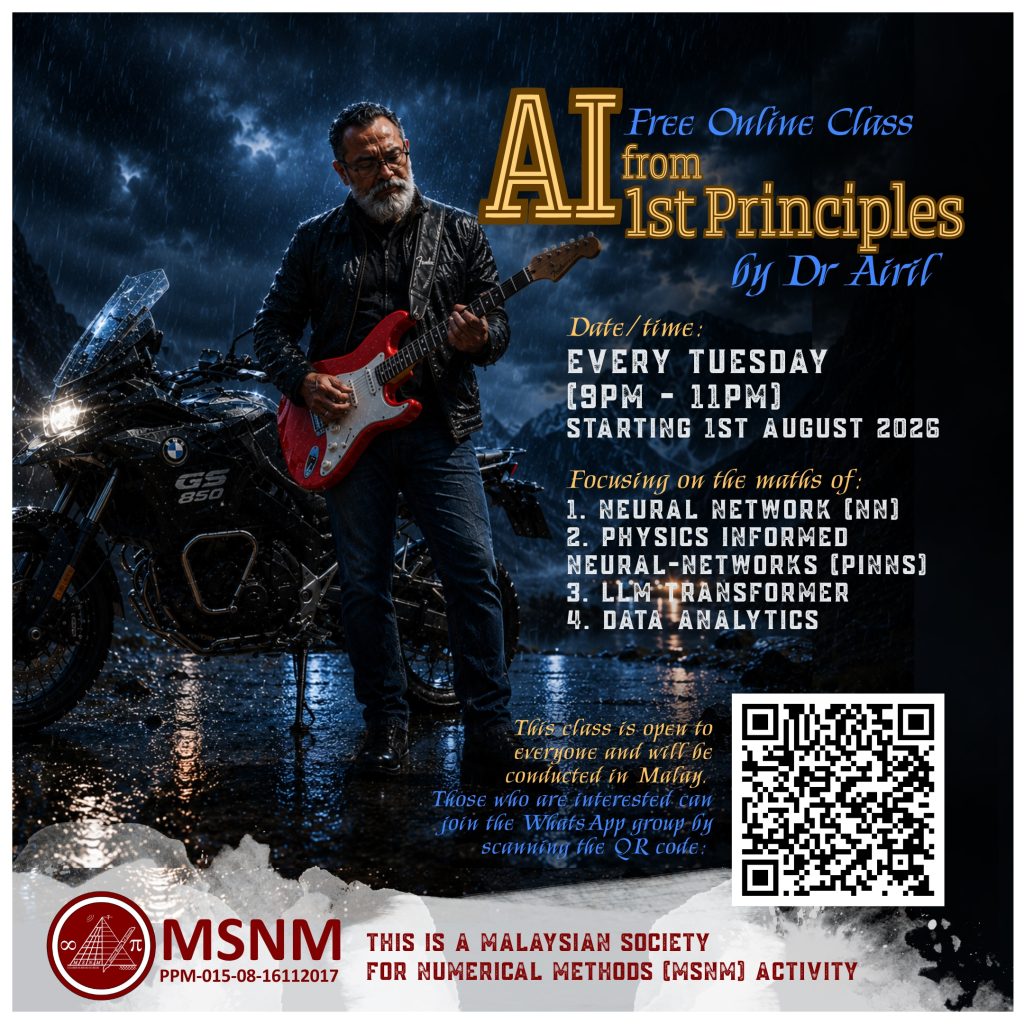
A free online Fundamentals of Artificial Intelligence (AI) course by Dr Airil Yasreen Mohd Yassin is designed to build a strong foundation in AI by introducing the fundamental mathematical principles behind today’s AI technologies.
Starting on 4 August 2026, classes will be held every Tuesday, 9:00–11:00 PM (Malaysia Time). The course is suitable for beginners and open to everyone interested in understanding AI from first principles, including students, researchers, educators, engineers, industry practitioners, and anyone interested in exploring the foundations of modern AI.
Throughout the course, participants will learn key topics including Neural Networks (CNN), Physics-Informed Neural Networks (PINNs), Large Language Models (LLMs) & Transformers, and Data Analytics. The course will provide insights into how AI systems are developed, how they learn from data, and the mathematical concepts that support modern AI applications.
1️⃣ For those who have not registered yet
Please complete your registration using the following link:
https://forms.gle/ArsRx4a35TpcSkum7
2️⃣ Join the WhatsApp Group
Please join the WhatsApp group for class updates, announcements, discussions, and learning resources:
https://chat.whatsapp.com/DqS4h7eJdVJ8LazYPR4sM5?s=cl&p=i&ilr=4
3️⃣ AI Learning Materials
The course modules and learning resources can be accessed through: https://github.com/msnm-official/ai_modules
WEEK 01
Introduction to AI and Neural Network Fundamentals
04 AUGUST 2026
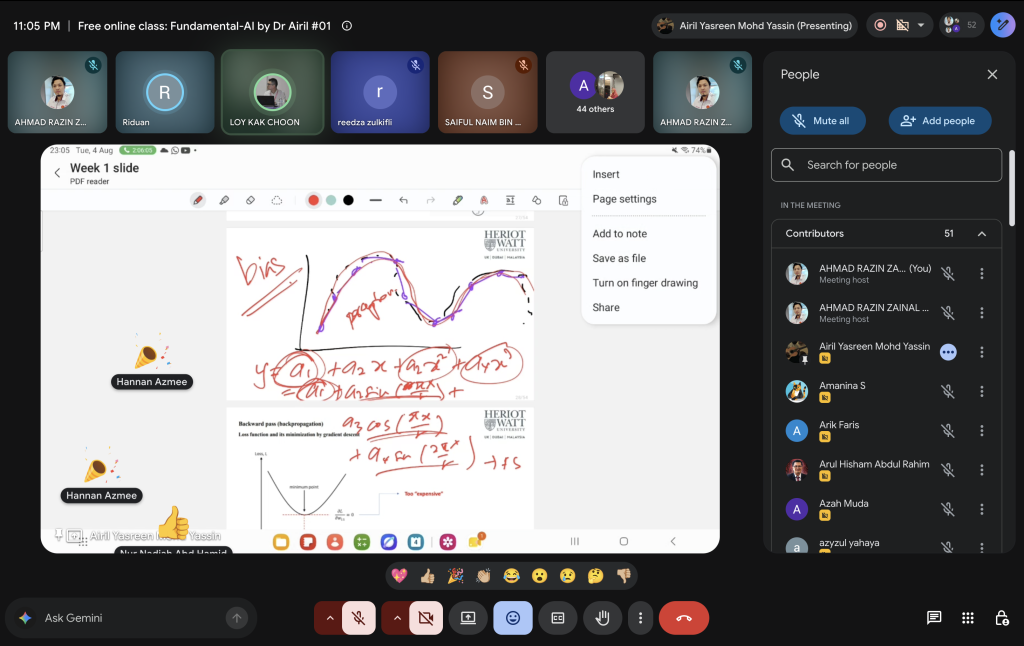
In Week 1, we introduced you to the artificial intelligence landscape, exploring the relationships between AI, Machine Learning (ML), Deep Learning (DL), and Generative AI. We exposed you to various DL architectures—like Feedforward Neural Networks (FFNN), RNNs, CNNs, and Transformers—alongside practical application examples. Next, we shifted our focus to the core structure of a shallow neural network, specifically diving into a single hidden layer network. Together, we thoroughly examined fundamental concepts, including the roles of neurons, channel weights, and biases at each layer.
…


WEEK 02
Backpropagation, Weight Updating, and Neural Networks from Scratch
11 AUGUST 2026
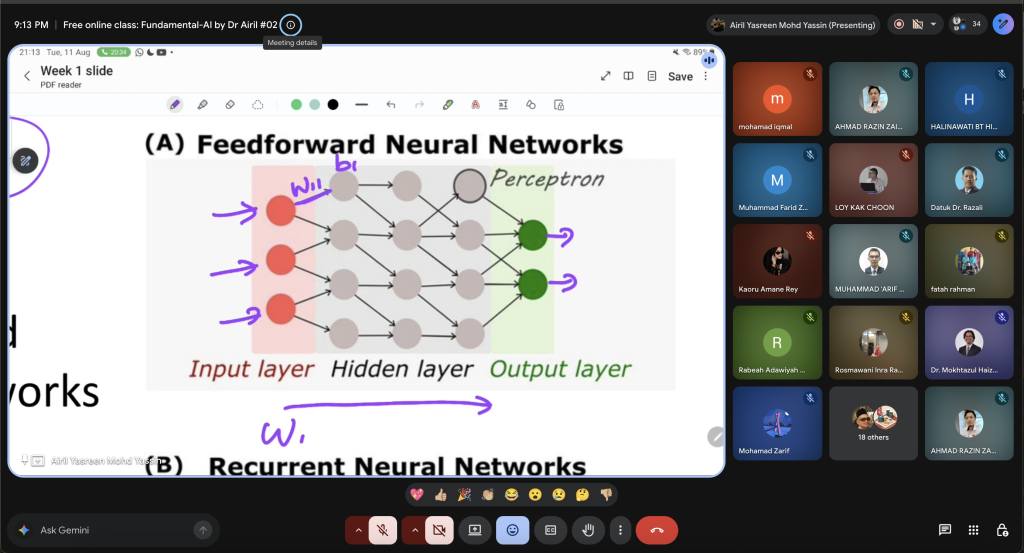
Building on the fundamental concepts of Neural Networks introduced in our first week, the second week took a more structured and hands-on approach to understanding how neural networks actually learn. We focused on the backpropagation and parameter updating processes, with particular emphasis on applying the chain rule to compute loss gradients and understand how errors are propagated through the network. To strengthen this understanding, we also implemented a neural network entirely from scratch, without relying on any AI or deep learning libraries. This allowed us to explore the underlying computations directly and develop a solid foundation before moving on to PyTorch and other libraries in the following week.
WEEK 03
From Neural Network Fundamentals to Practical PyTorch
18 AUGUST 2026
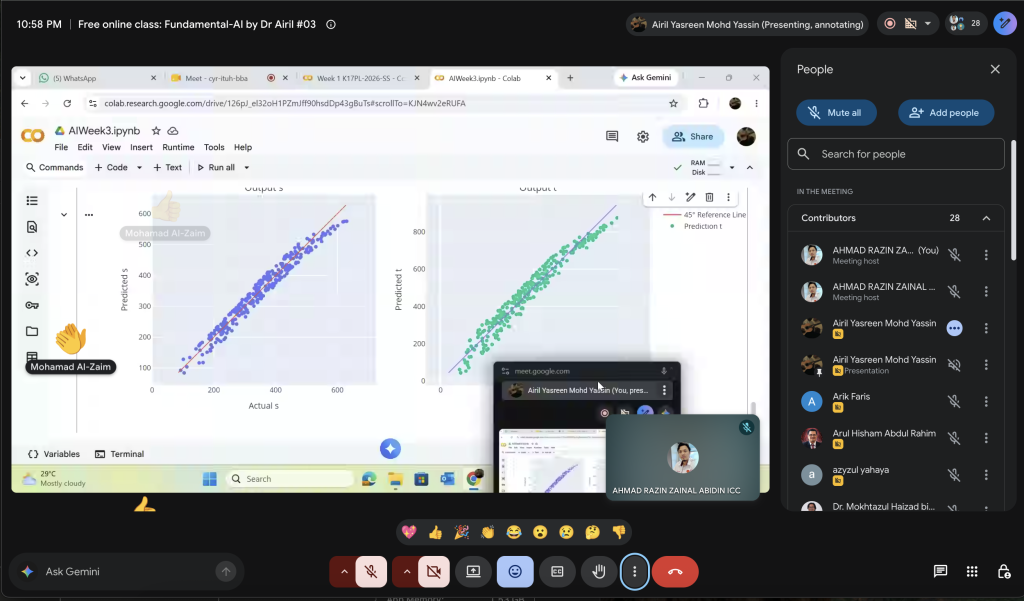
Building on the first two weeks, where we used a simple neural network and implemented the computations from scratch to understand the mathematics behind it, Week 3 marked our transition from first principles to practical automation. In practice, frameworks such as PyTorch and TensorFlow/Keras provide standard libraries for constructing neural networks, selecting activation and loss functions, optimizers, and automating backpropagation and parameter updates. In this session, we introduced PyTorch and connected these automated processes directly to the mathematical concepts developed previously. This progression reflects the philosophy of the course: understanding the fundamentals behind the tools, enabling us to use AI technologies more effectively and ultimately develop new ideas, innovations, and research solutions.
…


WEEK 04
Convolutional Neural Networks and Engineering Applications
25 AUGUST 2026
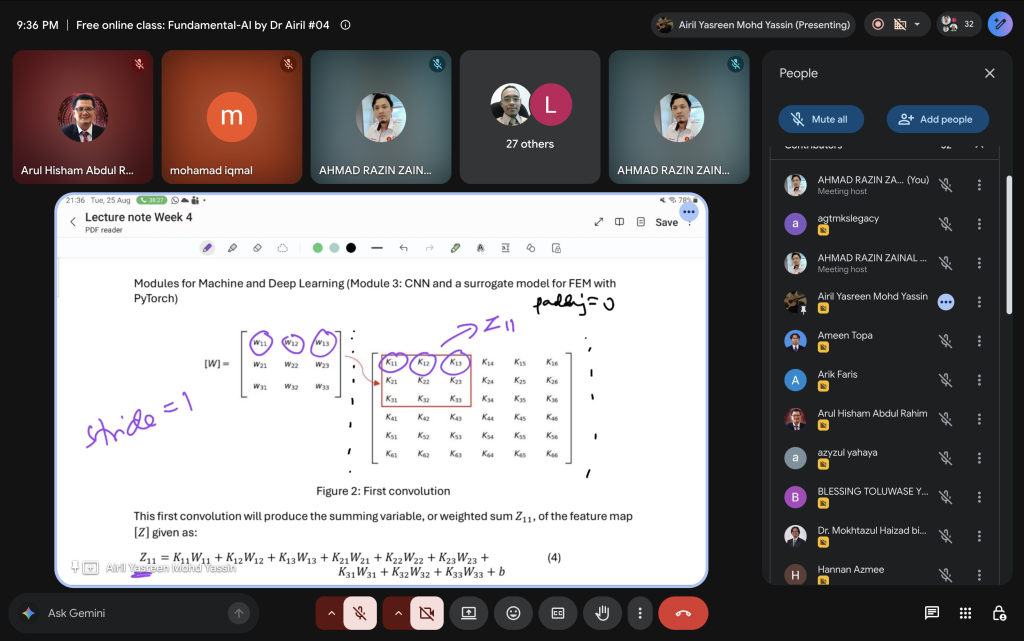
Building on the mathematical foundations and PyTorch implementation introduced in the earlier weeks, Week 4 focused on understanding the mathematics behind Convolutional Neural Networks (CNNs) and their application to engineering problems. In this session, we explored the fundamental operations of CNNs before developing a CNN–FFNN surrogate model step by step for a simply supported beam problem based on the Finite Element Method (FEM), represented by the governing equation ([K]{D}={F}). A total of 5,000 labelled datasets were generated for training and validation, with the model trained to predict the displacement degrees of freedom ({D}) from the stiffness matrix ([K]) and load vector ({F}). This session continued the course philosophy of understanding AI mathematically through engineering arguments, while demonstrating how deep learning can be applied directly to practical engineering problems.
WEEK 05
From Neural Network Fundamentals to Practical PyTorch
SCHEDULED FOR 01 SEPTEMBER 2026
Google meet link: meet.google.com/ctm-rbbi-gsw
Building on the introduction to Convolutional Neural Networks and engineering surrogate modelling in Week 4, Week 5 will likely shift our attention towards Recurrent Neural Networks (RNNs) and their application to sequential and time-dependent data. We will explore the fundamental mathematical ideas behind recurrent connections, hidden states, and how information is propagated from one time step to another, before relating these concepts to practical implementation in PyTorch. The session will also examine why RNN-type architectures are particularly useful for problems involving time histories, signals, sensor measurements, and other forms of sequential engineering data. As in the previous modules, the emphasis will remain on understanding the mathematics and computational logic behind the network rather than treating AI as a black box, providing a foundation for more advanced sequence models and real-world AI applications in the following sessions…
…

Note (Week 05)

Recorded Video (Part 1)

Recorded Video (Part 2)