
Finite Element Method
from First Principles
A structured learning archive by Dr Airil Yasreen Mohd Yassin — numerical methods, mechanics, mathematical formulation and practical applications.
Learn the mathematics behind the method.
WELCOME ALL !!
Dr Airil Yasreen Mohd Yassin is offering a free online Finite Element Method (FEM) course designed to build strong foundations in numerical methods and computational mechanics. Starting on 3 June, classes will be held every Wednesday, 9:00–11:00 PM, over approximately 12 weeks. The course begins from first principles, making it suitable for beginners, and follows the team’s FEM textbooks. It also provides a pathway to more advanced topics, including meshless methods, NURBS, and the Numerical Derivation Method (NDM).
1️⃣ For those who have not registered yet
Please complete your registration using the following link:
[https://forms.gle/ArsRx4a35TpcSkum7]
2️⃣ Join the WhatsApp Group
Please join the WhatsApp group for updates and discussions using the following link:
[https://chat.whatsapp.com/DqS4h7eJdVJ8LazYPR4sM5?s=cl&p=i&ilr=4]
3️⃣ Download the Red Book & Blue Book
The PDF books can be downloaded from the following link:
[https://github.com/msnm-official/fem_books]

Learning journey & resources.
All original teaching summaries, lecture notes and recorded video links are retained below.
Introduction to numerical methods

Galerkin WRM approach & FEM
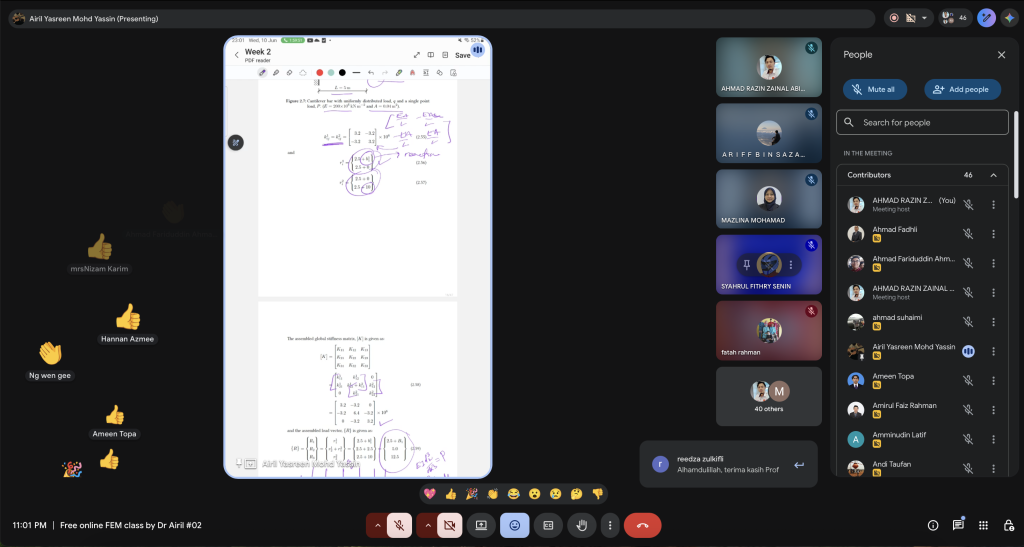
Higher-Order FEM for Bar Element + Beam Problem
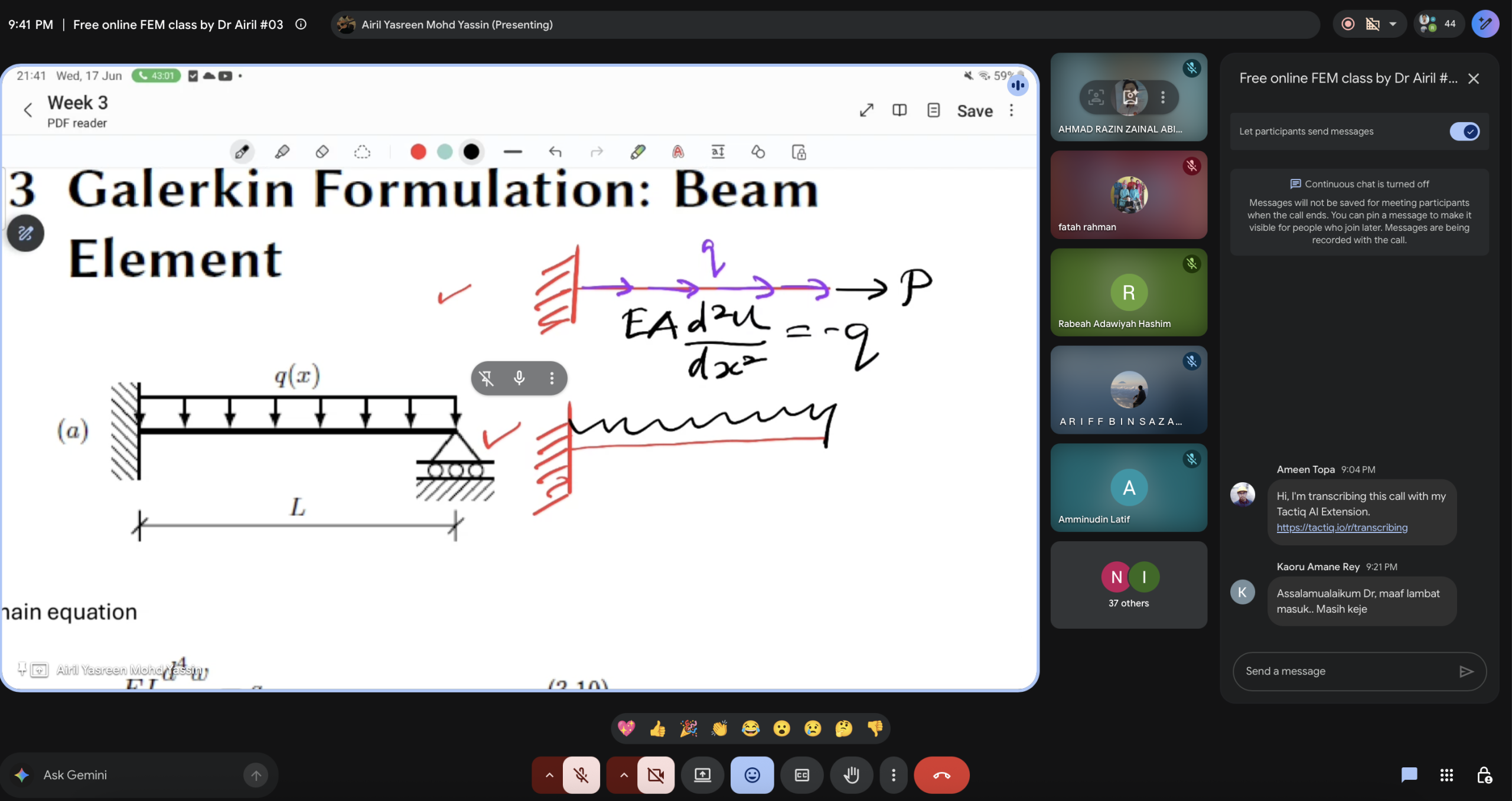
Derivation of Differential Equations – 1D and 2D Applications
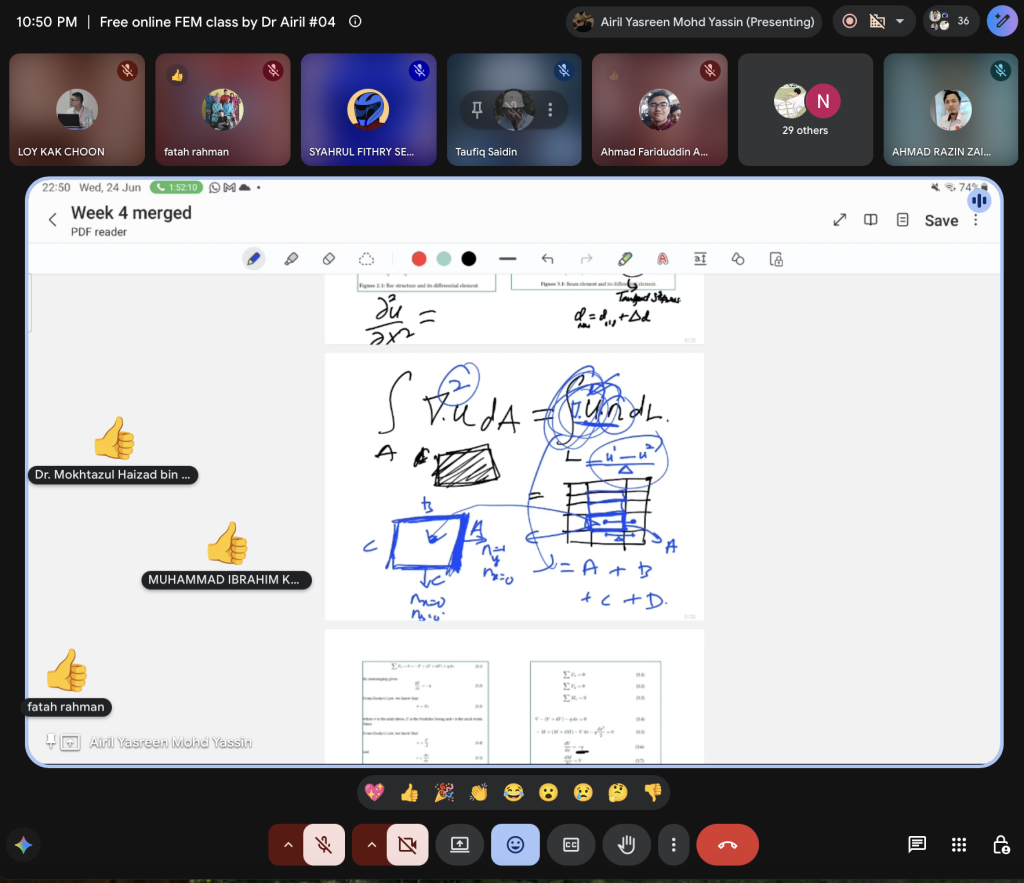
Extension of FEM to 2D Heat Transfer Problems
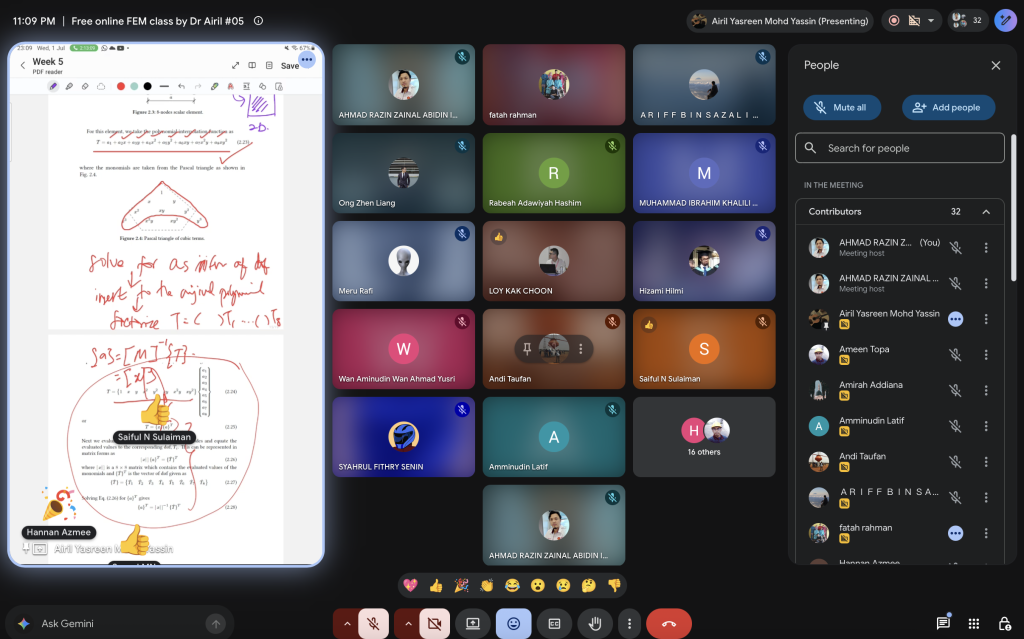
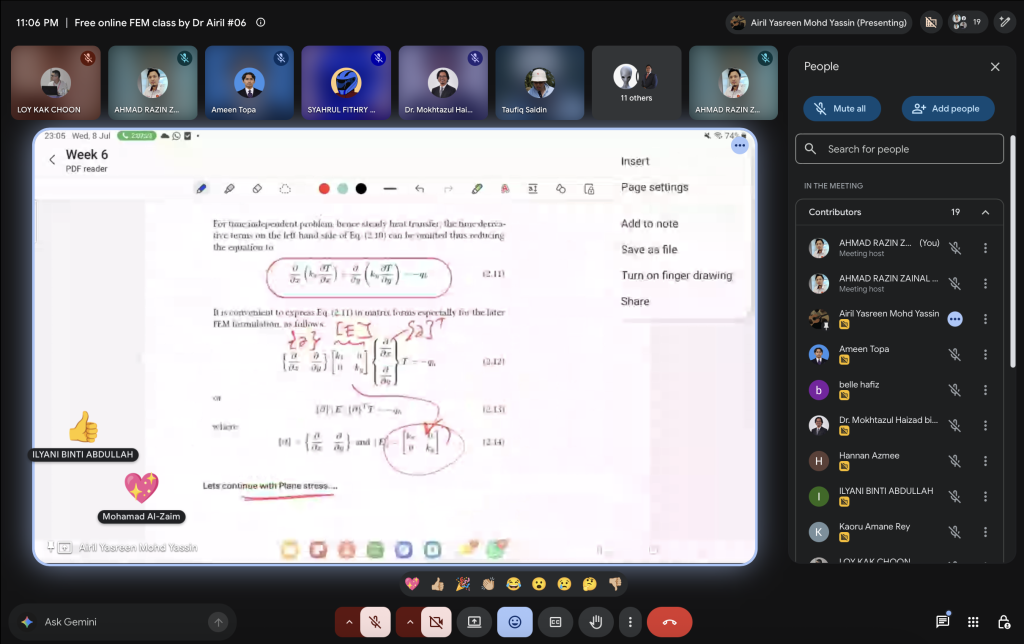
From Heat to Stress: FEM for 2D Plane Stress
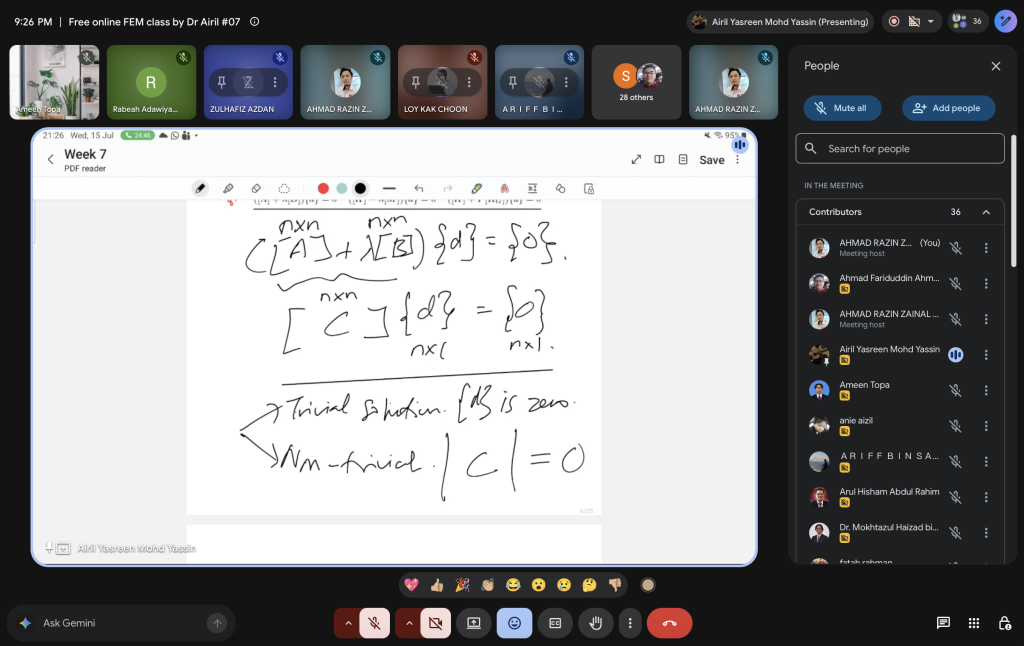
Application to Eigenvalue Problems: Buckling
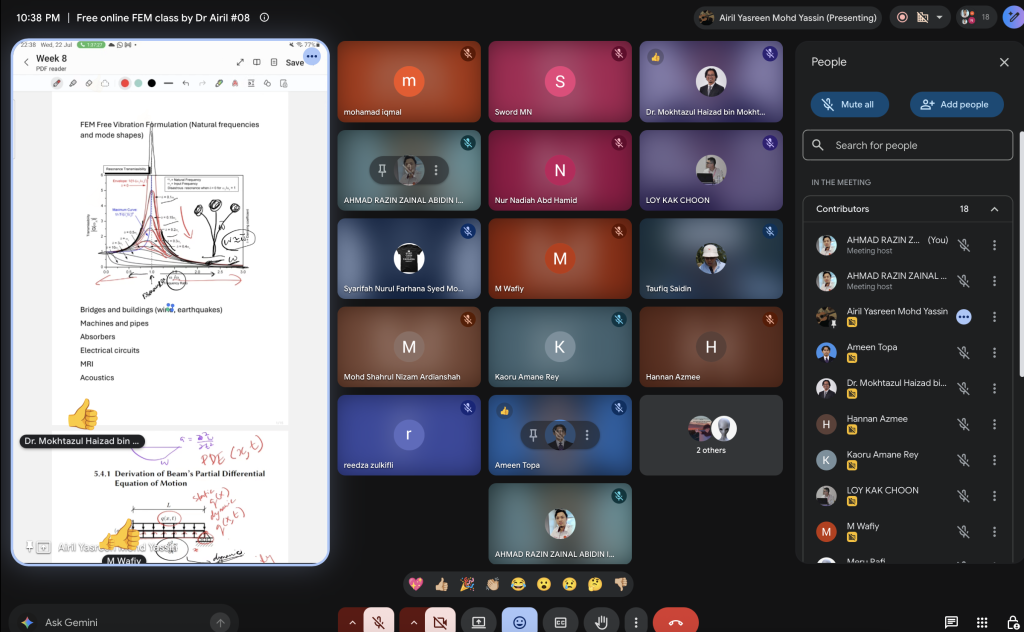
Application to Eigenvalue Problems: Free Vibrations
From Theory to Code: AI-Powered FEM Beam Analysis

Application to Dynamic Problems: Forced Vibrations
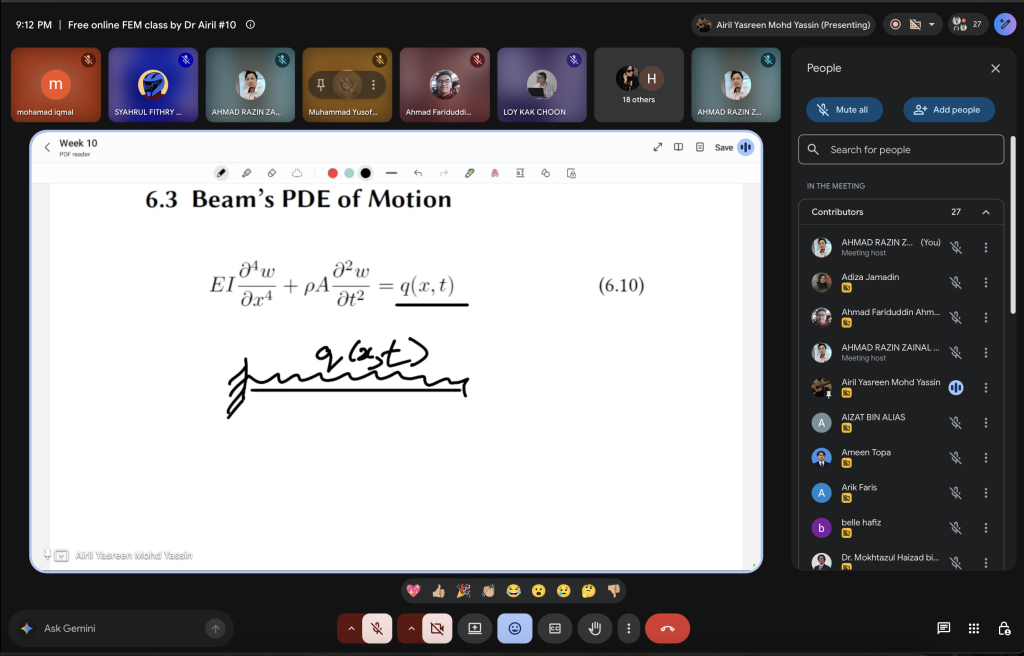
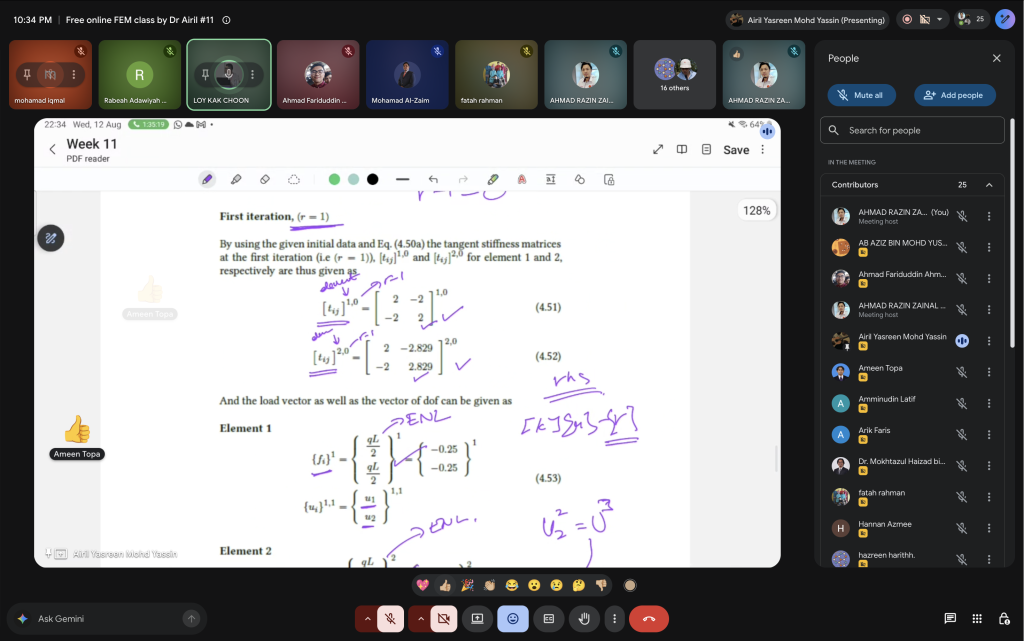
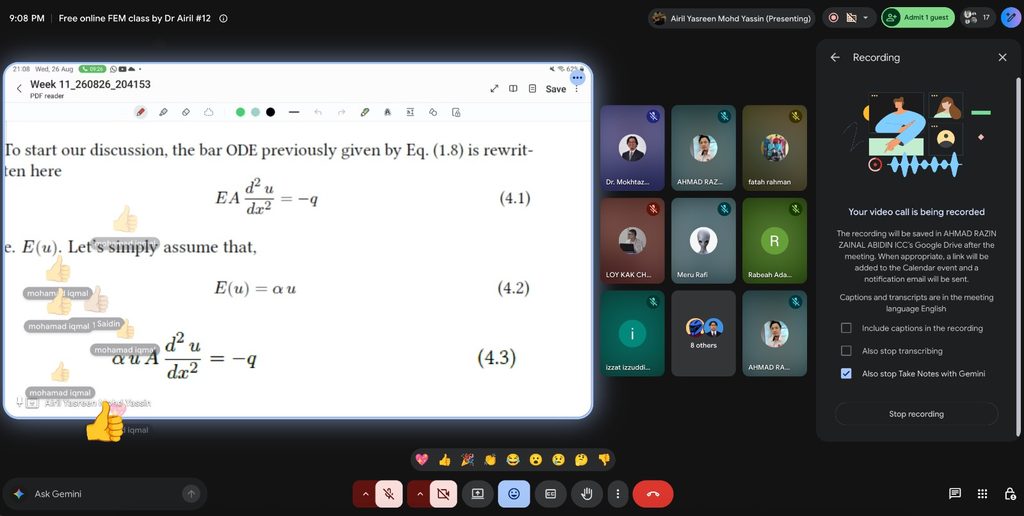
Nonlinear FEM: Picard and Newton–Raphson Methods
Nonlinear FEM Formulation: Newton–Raphson, Tangent Stiffness & Tensor Algebra
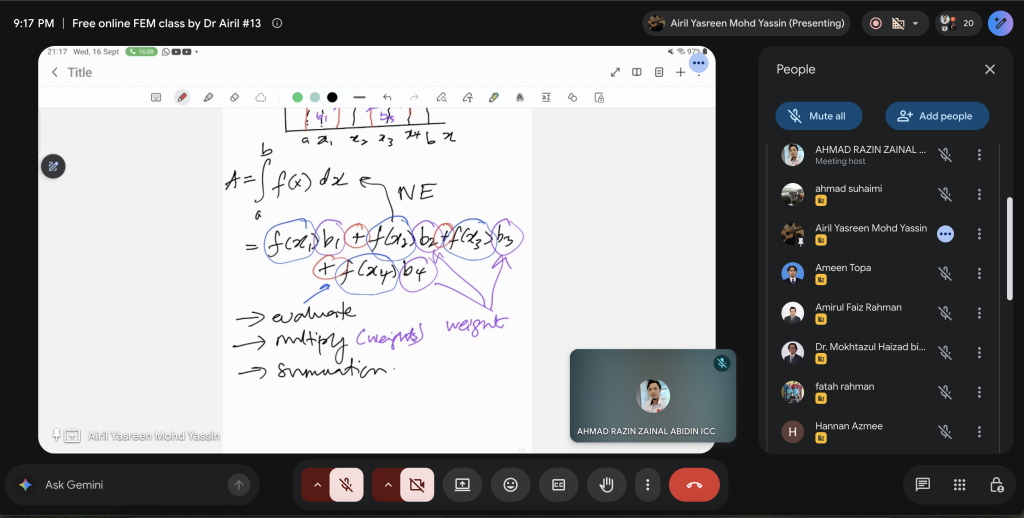
Numerical Integration for Finite Element Analysis
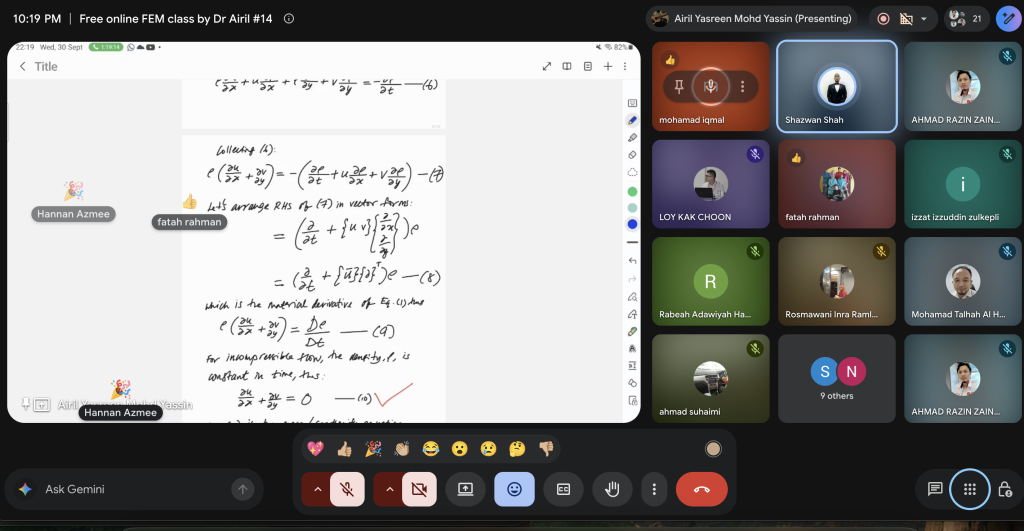
Navier–Stokes: Governing Equations and Assumptions for 2D
We also introduced the Eulerian description of fluid motion and the material derivative, which combines local and convective acceleration. The mass-conservation equation was then derived using a differential control element, followed by the x- and y-momentum equations based on Newton’s second law. Stress components were expressed using pressure, deviatoric stress, and Newtonian constitutive relations, leading to the final set of 2D incompressible Navier–Stokes equations. The session also highlighted the importance of engineering assumptions through comparisons with Euler–Bernoulli and Timoshenko beam theories. In the next session, we will introduce Physics-Informed Neural Networks (PINNs) before returning to finite element analysis..
Keep learning. Keep exploring.
These resources are preserved as part of the MSNM learning archive. For enquiries about the society, please contact admin@msnm.com.my.